

Forces of Western Europe: A Qualitative Analysis
Introduction: The Strategic Imperative of the Fractured Era
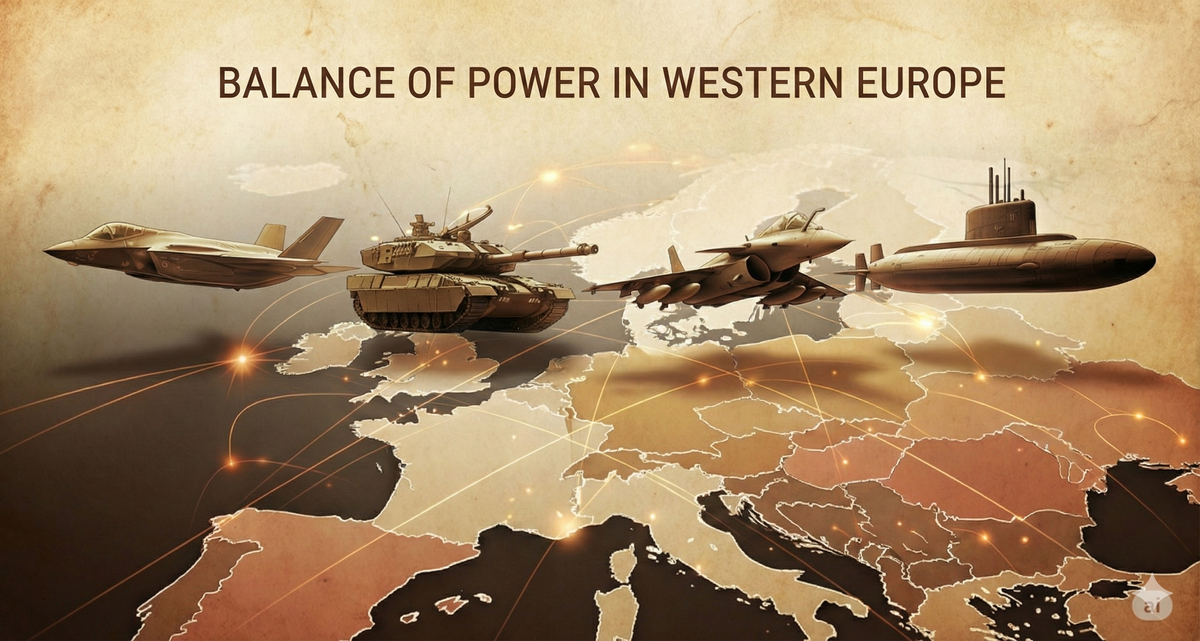
The security architecture of Western Europe has entered a period of profound structural destabilization, characterized not merely by the re-emergence of high-intensity conflict on its periphery but by the internal decomposition of the post-Cold War security guarantee. This Net Assessment, commissioned to evaluate the military balance of five key Western European powers—the United Kingdom, France, Germany, the Netherlands, and Belgium—departs from traditional threat-based analyses that focus exclusively on a monolithic "Russian threat." Instead, it operates under the assumption of a "fractured security arrangement," a scenario in which the United States' role as the guarantor of European defense is severely degraded, unreliable, or absent entirely.
In this fractured environment, the metric of military value shifts from "interoperability with US forces" to "sovereign generation of combat power." The essential question becomes whether these five nations, representing the industrial and demographic core of Western Europe, can generate sufficient deterrence and warfighting capability to secure their interests independently. This assessment differentiates sharply between current actual capabilities—often defined by hollow force structures, ammunition deficits, and training backlogs—and future planned capabilities slated for the 2030-2035 horizon.
The analysis reveals a disturbing divergence between political rhetoric and military-industrial reality. While defense budgets have nominally increased across the board, with Germany’s Zeitenwende and Belgium’s STAR plan representing historic shifts in fiscal policy, the conversion of this capital into operational readiness is being arrested by structural bottlenecks. These include the atrophy of the defense industrial base (DTIB), demographic crises in recruitment, and a bureaucratic inability to transition from peacetime efficiency models to wartime resilience. Consequently, the assessment estimates a low probability that the stated capability targets for 2030 will be met, leaving Western Europe with a critical "window of vulnerability" between at least 2025 and 2030.
Strategic Context: The Mechanics of Decoupling
To understand the capabilities of Western Europe, one must first quantify the "US Void"—the specific functional gaps that would emerge in a fractured security arrangement where American strategic enablers are withdrawn. For decades, European force planning has relied on the assumption that the US military would provide the "backbone" of logistics, intelligence, and high-end kinetic support, allowing European armies to function as specialized "limbs."
The Enabler Deficit
The most immediate impact of a fractured security landscape is the loss of critical force multipliers that European nations have largely ceased to cultivate indigenously.
Strategic Airlift and Mobility
The ability to project heavy force—specifically armored brigades—over strategic distances is heavily dependent on US Air Force C-17 and C-5 fleets. While the Airbus A400M has entered service with France, Germany, the UK, and the Benelux, it occupies a tactical-strategic middle ground. It cannot carry Main Battle Tanks (MBTs) like the Leopard 2 or Challenger 3. In a scenario requiring the rapid movement of heavy armor to the Eastern Flank or a southern theater without US assistance, European forces would be reliant on rail infrastructure. However, current assessments indicate that rail logistics in Eastern Europe are often incompatible with Western heavy armor due to gauge differences and bridge weight limits, creating bottlenecks that would be fatal in a high-tempo conflict (Efstathiou, 2019).
Suppression of Enemy Air Defenses (SEAD)
Perhaps the most critical deficiency is in the domain of SEAD. The Royal Air Force (RAF) and the German Luftwaffe retired their dedicated anti-radiation missile stocks (such as ALARM) following the Cold War, operating under the assumption that US Navy Growlers or USAF F-16CJ fleets would clear adversary Integrated Air Defense Systems (IADS). In a fractured scenario, European fourth-generation fighters (Typhoon, Rafale) and even small numbers of fifth-generation F-35s would face dense A2/AD (Anti-Access/Area Denial) environments with no organic means to suppress surface-to-air missile threats. This renders the air fleets of the assessed nations highly vulnerable and potentially unusable for deep strike missions (Andrew, 2023).
Intelligence, Surveillance, Targeting, Acquisition and Reconnaissance (ISTAR)
While France has pursued sovereign space capabilities (CSO, Helios), and Germany operates the SARah radar satellites, the refresh rates, resolution, and integration of these systems lag significantly behind the US architecture. A European command structure operating without access to the full spectrum of US National Reconnaissance Office (NRO) data would suffer from "information darkness," degrading the targeting cycles required for long-range precision fires (Wall et al., 2023).
The Industrial-Demographic Vise
Beyond the loss of US enablers, the five nations are constricted by two internal factors that limit their ability to scale military power.
The Fragility of "Just-in-Time" Logistics
The defense sectors of the UK, Germany, and France have spent thirty years adapting to the logic of the civilian market: efficiency, lean inventories, and just-in-time delivery. This has resulted in the elimination of surge capacity. The crisis in ammunition production, specifically 155mm artillery shells, is not merely a funding issue but a physical shortage of raw materials. The production of nitrocellulose (gunpowder) and specialized steels has become a strategic choke point. Europe's reliance on imported cotton linters (a precursor for nitrocellulose) from China creates a secondary vulnerability; in a fractured global security environment, these supply chains could be severed, arresting ammunition production regardless of factory capacity (Dossi, 2024).
The Human Capital Crisis
Recruitment and retention have reached emergency levels across all five nations. The sociological disconnect between the military and the civilian population, exacerbated by competitive civilian labor markets, means that even fully funded force structures cannot be manned.
- Germany: The Bundeswehr is shrinking despite plans to grow to 203,000 personnel. The demographic pool of eligible recruits is contracting, and the military career is viewed as unattractive (Nagy, 2025).
- UK: The specialized trades—pilots, nuclear engineers, cyber specialists—are seeing outflows that exceed inflows. The "hollowing out" of the mid-career technical cadre means that experience is being lost faster than it can be replaced (Jones, 2023).
- Netherlands: The Dutch military faces thousands of vacancies, forcing it to explore novel integration models with Germany simply to field combat units (Helmer, 2023).
United Kingdom: The Dilemma of the Hollow Trident
The United Kingdom remains, on paper, the most capable expeditionary power in Europe, possessing the full triad of nuclear forces, carriers, and special operations forces. However, a detailed net assessment reveals a force structure that is brittle, lacking the depth to sustain high-intensity operations beyond a few weeks. The 2025 Strategic Defence Review (SDR) attempts to realign the UK's posture towards a "NATO First" policy, implicitly acknowledging that the "Global Britain" ambitions of the previous decade were fiscally unsustainable (Barrie et al., 2025).
Maritime Capabilities: The Surface Fleet Precipice
The Royal Navy (RN) is currently navigating a dangerous transition period where legacy platforms are being retired faster than their replacements can be built, creating a "hull deficit" that threatens its core missions.
Current Capability Reality
As of mid-2025, the surface fleet numbers have dipped below critical thresholds. The Type 23 frigate fleet, the workhorse of the RN's anti-submarine warfare (ASW) capability, is aging rapidly, with extended hull lives leading to poor availability. The availability metric is further degraded by a severe shortage of skilled engineering ratings and key warfare officers.
- Carrier Strike Vulnerability: The Queen Elizabeth-class carriers are operational, but their deployment relies on the Royal Fleet Auxiliary (RFA) for solid support (stores) and tankers (fuel). The RFA is currently experiencing a manpower collapse, with strikes and recruitment failures leaving essential support ships in port. Without the RFA, the carriers are tethered to friendly ports, negating their blue-water projection capability (Brooke-Holland, 2025).
- The Lethality Gap: While the RN plans to introduce the Naval Strike Missile (NSM) to replace the retired Harpoon, integration has been slow. For land attack, the fleet relies almost entirely on US-supplied Tomahawk missiles launched from Astute-class submarines. In a scenario where US stocks are withheld or prioritized elsewhere, the RN lacks a sovereign deep strike capability.
Britain's nuclear submarine fleet is in a state of complete disrepair. According to rear admiral Mathias the UK's silent service is facing an "unprecedented situation from which it is unlikely to recover." Among the numerous problems are the delivery of new attack boats, which has reached record delays. Patrols went from an average of 70 days (during the cold war) to 200 days, due to a lack of available submarines. The back-log for Astute-class submarine maintenance is long an the new Aukus-class boats are not going to be delivered any time soon (Cotterill, 2025).
Future Planned Capabilities (2030-2035)
The future fleet is predicated on the successful delivery of the Type 26 (City-class) and Type 31 (Inspiration-class) frigates.
- Type 26: Designed as a world-leading ASW platform, the program has suffered from the typical delays of complex first-in-class builds. The target is to have the first vessels operational by the late 2020s, but full operational capability (FOC) for the class of eight ships is unlikely before the mid-2030s (Brooke-Holland, 2025).
- Type 31: These general-purpose frigates are intended to boost hull numbers. While simpler and likely to be delivered on time, they lack the high-end ASW and air defense systems required for high-intensity survivability against a peer navy, effectively serving as constabulary vessels rather than warfighting assets in a contested North Atlantic.
| Class | Role | 2025 Status | 2035 Target | Assessment of Target Met |
|---|---|---|---|---|
| Type 23 | ASW/GP Frigate | 10-11 (retiring) | 0 | Certain (Retirement) |
| Type 26 | ASW Frigate | Trials / Build | 8 Operational | Medium-Low (Delays likely) |
| Type 31 | GP Frigate | Build | 5 Operational | Medium-High |
| Type 45 | Destroyer | 6 (PIP Upgrade) | Replacement (Type 83) | Low (Type 83 concept immature) |
Air Power: The Training Pipeline Collapse
The Royal Air Force (RAF) faces a crisis that money alone cannot immediately solve: a broken pilot training pipeline. This bottleneck is the single greatest constraint on UK air power generation.
The Pilot Deficit
Despite the procurement of F-35B aircraft, the RAF struggles to generate pilots to fly them. The Military Flying Training System (UKMFTS) has been plagued by chronic unavailability of aircraft and instructors.
- The Waiting Game: Trainee pilots have faced holds of up to four years between flying courses. This "fades" their skills and destroys morale, leading to high attrition before they even reach the frontline. While recent reports suggest holding times are reducing (e.g., fast jet holds down to 3-4 months), this data may mask the fact that the total throughput remains far below the requirement to man expanding squadrons (Jones, 2023).
- Infrastructure Lag: The Ministry of Defence has awarded a £300-400 million contract to upgrade training infrastructure at RAF Cranwell and RNAS Culdrose, including new simulators and Texan T1 integration. However, the lag time for these investments to produce combat-ready pilots is 3-5 years. Consequently, the RAF will remain pilot-constrained through the critical 2025-2029 window (Gosselin-Malo, 2025).
Operational Impact
The 2025 SDR indicates a potential acquisition of F-35A (land-based) jets to complement the carrier-borne F-35B. While this would increase fleet mass, without a resolution to the pilot crisis, these sophisticated airframes will remain grounded capability. Furthermore, the RAF's lack of organic SEAD capability means these assets would be forced to operate conservatively in a fractured security environment, relying on stealth rather than active suppression to survive.
Land Forces: The Ammunition and Equipment Cliff
The British Army is arguably the most degraded of the three services relative to its historical baseline and the requirements of land warfare in Europe.
The Munitions Crisis
War-gaming scenarios conducted by RUSI and internal MoD assessments reveal a catastrophic lack of depth in ammunition stockpiles. In a high-intensity artillery duel, the British Army would exhaust its 155mm shell stocks within one week to ten days (Watling et al., 2022). While the 2025 SDR allocates £1.5 billion for new munitions factories and promises 7,000 UK-built long-range weapons, industrial lead times mean these stocks will not be replenished to credible levels before 2028-2030. The UK is competing for the same raw materials (gunpowder, steel) as every other rearming nation.
Vehicle Obsolescence
The delay and cost overruns of the Ajax reconnaissance vehicle program have left a gaping hole in the Army's digitized reconnaissance capability (Cotterill, 2025). Simultaneously, the Challenger 2 fleet is being cannibalized to produce 148 Challenger 3 tanks. This number is insufficient to equip a full armored division capable of sustaining attrition. The "Warfighting Division" the UK has promised to NATO is, in 2025, a composite formation that would struggle to deploy as a coherent whole without significant notice (Brooke-Holland, 2025).
Assessment of UK Viability
The United Kingdom retains pockets of excellence—Tier 1 Special Forces and intelligence—but lacks the "mass" required for continental warfare. The likelihood of the UK meeting its "Warfighting Division" readiness target by 2030 is Low, primarily due to the intractable nature of the industrial ramp-up and the pilot training backlog.
France: The Fragile Spearhead of Strategic Autonomy
France occupies a unique position in this assessment as the only continental power with a full-spectrum military model (Modèle d'Armée complet) and an indigenous nuclear deterrent. The French doctrine of "Strategic Autonomy" makes them theoretically the most prepared for a fractured security environment. However, the Loi de Programmation Militaire (LPM) 2024-2030 reveals a tension between high-intensity ambition and fiscal reality.
Doctrine and Readiness: "Winning the War Before the War"
French military culture has aggressively pivoted back to high-intensity state-on-state conflict. The "Polaris" series of exercises is designed to stress-test the Marine Nationale and Armée de Terre against peer adversaries in multi-domain environments (FMAF, 2025).
The Scorpion Force
France has successfully modernized its medium-weight forces with the Scorpion program (Griffon, Jaguar, Serval vehicles). These wheeled vehicles offer high strategic mobility, allowing French forces to self-deploy across Europe's road networks faster than tracked heavy armor.
The Mass Problem
While the equipment is modern, the quantities are insufficient for a war of attrition. The concept of "bonsai armies"—miniature versions of comprehensive forces—means France can perform every function of war (air superiority, ASW, deep strike) but only for a limited duration and over a limited frontage.
Land Forces: The Artillery and Logistics Constraint
The CAESAR 155mm self-propelled howitzer has proven its effectiveness, but the French Army possesses far too few of them (109 units ordered by 2026 + 60 existing units) to match the fire density of a Russian-style artillery army.
Ammunition Production
France is expanding its sovereign production of modular charges via Eurenco, aiming for 1 million charges annually from the Bergerac site. This is a critical sovereign capability that reduces dependence on external suppliers. However, this capacity will not be online until 2026-2027, leaving a vulnerability window (Cranny-Evans, 2025).
High-Intensity Attrition
Recent military exercises such as HEMEX ORION in France have demonstrated how difficult it is for a French division or even more an army corps to honor its “kill contract” of 30% enemy attrition in the deep area with current firepower (Unitary Rocket Launchers and 155mm CAESAR howitzers), not only because of the lack of tubes and their limited range, but also because of the insufficient availability of sensors for the acquisition of targets, which are very numerous on a high-intensity battlefield.
Not only does France lack the mass to suffer attrition, it also lacks the firepower, sensors and networked capabilities required to inflict attrition upon enemy forces (Tenenbaum, 2023).
Naval and Air Domains: Sovereignty at a Cost
As a response to significant naval developments by Türkiye and China, the French military has invested heavily in the expansion of the Marine Nationale.
Naval
The Marine Nationale is prioritizing the FDI (Defense and Intervention Frigate) program. The first ship, Amiral Ronarc'h, is entering service, featuring advanced digital architecture and Sea Fire radars. These ships are designed for high-intensity warfare but, like the UK, the numbers are small (target of 3 FDIs by 2027, and 7 additional OPVs). Combat attrition of even two or three hulls would render the fleet combat-ineffective for major operations (Auran, 2024).
Air
The "All Rafale" target for the French Air and Space Force is delayed, forcing the retention of older Mirage 2000Ds. Crucially, France lacks heavy strategic airlift and robust SEAD capabilities. While the A400M provides tactical lift, France would struggle to move a heavy division to Romania or Poland rapidly without rail or allied heavy air support (Efstathiou, 2019).
Assessment of French Viability
France is the most politically and doctrinally prepared nation for a fractured security environment. Its DIB is state-directed and resilient. However, its "mass" is insufficient to act as the sole guarantor of European security. France can lead a coalition, providing the nuclear backstop and C2 framework, but it requires partners to provide the bulk of the forces. Likelihood of meeting LPM 2030 targets is Medium, but volume targets may be shaved due to potential delays, inflation and fiscal constraints.
Germany: The Paralysis of the Central Power
Germany represents the "center of gravity" for any conventional European defense. Its geographical position, economic weight, and industrial potential make it indispensable. However, the Zeitenwende (turning point) declared in 2022 has, by 2025, largely failed to translate into tangible combat power. Germany currently represents the critical failure point in the Western European defensive line.
Brigade Readiness
Parliamentary Commissioner reports indicate that combat readiness of the army's brigades has fallen from roughly 66% to 50% between 2022 and 2025 (Nagy, 2025).
The "LitBrig" Cannibalization
The political commitment to permanently station a heavy brigade (Brigade 45) in Lithuania by 2027 is consuming the entire readiness bandwidth of the German Army (Budginaite-Froehly, 2025). To equip and man this single high-readiness formation, the Bundeswehr is stripping personnel and equipment from units stationed in Germany, effectively hollowing out the home defense force to create a trip-wire presence in untenable terrain.
Personnel Crisis
The goal of reaching 203,000 troops by 2031 is widely regarded as unattainable. The force is currently shrinking due to demographic headwinds and a competitive civilian labor market (Conradi et al., 2025). A shortfall of 20,000+ personnel persists, and the reintroduction of mandatory conscription—while debated—remains politically toxic and administratively difficult to implement rapidly.
The Procurement Bureaucracy
The €100 billion Sondervermögen (special fund) has been hampered by the rigid and unresponsive nature of the German procurement agency (BAAINBw), which prioritizes legal compliance and process over operational urgency.
Digitization Failure
The "Digitization of Land-Based Operations" (D-LBO) program is years behind schedule. German units deploying to NATO's eastern flank often rely on unsecure, unencrypted analog radios, a potentially fatal flaw when facing an adversary with advanced Electronic Warfare (EW) and signals intelligence capabilities (Krempl, 2025). This renders German command and control highly vulnerable to interception, disruption or manipulation.
Industrial Disconnect
While German industry (Rheinmetall, KMW) is ramping up production, domestic orders were placed too late. Rheinmetall's new factory in Unterluess is a success story, projected to produce 350,000 artillery rounds annually, but much of this output is earmarked for export or Ukraine rather than immediately replenishing German stocks (ArmyTechnology, 2025).
Strategic Enablers: The European Sky Shield Initiative (ESSI)
Germany’s primary contribution to future capability is the European Sky Shield Initiative (ESSI). Recognizing the dire state of its air defenses, Germany has opted for an off-the-shelf procurement strategy, selecting the US Patriot (long-range), the German IRIS-T SLM (medium-range), and the Israeli Arrow 3 (exo-atmospheric/anti-ballistic).
Strategic Implication
This move has caused friction with France, which prefers European solutions (SAMP/T). However, it demonstrates a German pragmatic realization that its industry cannot deliver a sovereign solution in time.
Effectiveness
Germany has opted to buy Patriot systems despite their extremely low effectiveness (MilitaryWatch, 2025). When going up against an ISTAR-strike complex equipped with cheap and expendable drones as well as fast precision guided munitions with small intercept windows, the cost/kill ratio does not justify such expenses (NWISS, 2025). The Arrow 3 system is expected to provide initial operational capability by late 2025/2026. The effectiveness however, of exo-atmospheric interception has long been scrutinized and is unlikely to work in real-world combat (Postol, 2025).
Assessment of German Viability
Germany is currently a "checkbook power" with a broken military. The likelihood of the Bundeswehr meeting its NATO Force Model targets (three fully equipped combat divisions by 2031) is Very Low. The industrial base is in decline due to a lack of affordable energy, and the human capital and organizational agility required to field a warfighting army are absent.
The Benelux Cluster: Integration as a Survival Strategy
The Netherlands and Belgium illustrate the necessity of deep integration for small and medium powers in a high-threat environment. Unable to field full-spectrum forces individually, they have pursued a strategy of fusing their capabilities with each other and with Germany to generate relevant mass.
The Netherlands: The Agile Integrator
The Royal Netherlands Army has effectively ceased to operate as an independent standalone force, instead integrating its combat brigades directly into German Army divisions.
Integration Model
The 11 Airmobile Brigade is integrated into the German Division Schnelle Kräfte (DSK), the 43 Mechanized Brigade into the German 1st Panzer Division, and the 13 Light Brigade into the German 10th Panzer Division.
Risks
This deep integration provides the "mass" the Dutch lack but makes them hostage to German readiness failures. If the German division headquarters are incapable of secure command (due to the D-LBO failure mentioned above), the Dutch brigades are effectively paralyzed.
Sovereign Capabilities
Despite land integration, the Dutch are pursuing sovereign "Deep Strike" capabilities. Recognizing the need for long-range fires provided by U.S. supplied Tomahawks, the Netherlands is also exploring independent maritime-launched anti-ship missiles and expanding its PULS rocket artillery, as well as investing in space based ISR capabilities. This suggests a desire to attain some type independent ISTAR-strike capability (Eerste Kamer, 2024).
Belgium: The Free Rider's Awakening
Belgium has historically been one of NATO's lowest spenders, with a defense posture that atrophied significantly post-Cold War. The current government has labeled this a "period of national shame" and initiated the "STAR" plan to rebuild (Felstead, 2025).
Budgetary Shock
The ambition is to reach 2% of GDP by 2029. This represents a massive injection of capital that the Belgian defense organization is struggling to absorb efficiently.
Naval & Air
Belgium acts as a junior partner to the Netherlands in naval affairs (joint procurement of Anti-Submarine Warfare Frigates - ASWF) and to France in land affairs (Scorpion vehicle adoption). The F-35 transition is critical; the first aircraft have been delivered but pilot training and infrastructure at Florennes and Kleine-Brogel are still in transition (Ruitenberg, 2025). The retirement of F-16s creates a capability dip in the mid-2020s.
Land Forces
Belgium aims to make a second brigade available to NATO, but personnel shortages are acute. The force is being rebuilt almost from scratch in terms of heavy capability.
Assessment of Benelux Viability
The Netherlands is a highly capable "plug-in" force for a German corps, providing high-readiness brigades that are often better equipped than their German parent units. However, they lack independent operational capability in terms of command & control, support and logistics. Belgium is currently a liability, with a hollow force structure that will take a decade to rebuild. Their combined "Benelux" naval capability (MCM and Frigates) is technologically sophisticated but lacks mass and are dependent on foreign supply chains.
Functional Gap Analysis: The "US Void"
In the assumed "fractured security" scenario, the withdrawal of US assets reveals existential vulnerabilities that cannot be plugged by current European procurement plans before 2030.
The SEAD/DEAD Vacuum
US Air Force assets provide the vast majority of SEAD/DEAD (Suppression/Destruction of Enemy Air Defenses) capability in NATO (Bronk, 2023). Without it, European air forces cannot be expected to fly against real integrated air and missile defense networks.
European Capability
European air forces have neglected this mission set. There is no European equivalent to the EA-18G Growler (electronic attack) or the AGM-88G AARGM-ER (advanced anti-radiation missile) in widespread service.
Operational Consequence
Without SEAD, European air forces cannot dismantle an adversary's IAMD. This means they cannot provide Close Air Support (CAS) to land forces or conduct interdiction bombing without suffering prohibitive losses. The F-35 offers a partial solution through stealth, but European fleets are small (Netherlands, UK, Belgium, Germany) and possess limited internal payload. The lack of a dedicated electronic warfare escort capability severely limits the F-35's ability to operate persistently inside a threat ring.
Strategic Lift and Logistics
While PESCO projects on "Military Mobility" aim to improve cross-border movement, the physical infrastructure of Europe remains a constraint.
Rail vs. Air
Without US C-17s, the rapid deployment of a heavy armored division from Germany or France to the Baltics or Romania must occur by rail. The rail gauges in the Baltics however, are Russian-standard, requiring transloading. Bridges in Eastern Europe often cannot support the 70-ton weight of a Leopard 2A7V or Challenger 3. This physical reality imposes a "speed limit" on European reinforcement that an adversary could exploit to create a fait accompli before heavy forces arrive.
Lack of sovereign IAMD
The Russo-Ukrainian conflict and the 12-day air war between Israel and Iran have demonstrated that in modern air conflicts, interceptors are fired with a rate of up to hundreds per week.
Although European militaries use domestically produced systems like the IRIS-T, SAMP-T or Sky Sabre to supplement their American or Israeli counterparts, their interceptors are not nearly being produced at a rate that allows them to withstand the initial salvos in a scenario where a modern air conflict breaks out.
The Industrial Base
The ability to sustain a war depends on the Defense Technological and Industrial Base (DTIB). The current state of ammunition production is a strategic vulnerability.
The Gunpowder Choke Point
The production of artillery shells is limited not by steel casings but by propellant (gunpowder) and modular charges. Europe relies heavily on a few suppliers (Eurenco, Rheinmetall). The supply chain for nitrocellulose is fragile and lacks depth.
Targets vs. Reality
The EU target of 2 million shells/year by end-2025 is optimistic. Analysis of factory ramp-up times (e.g., Nammo's expansion or Rheinmetall's Hungarian plant) suggests that while capacity is growing (ArmyTechnology, 2025), the actual delivered rounds to stockpiles will lag significantly. Most current production is consumed immediately by Ukraine or exports, meaning European national stockpiles are not growing at the rate required to reach the "30 Days of Supply" metric by 2030.
Capability Forecast and Net Assessment (2025-2035)
The following matrix estimates the likelihood of the assessed nations meeting their force generation targets necessary for independent defense in a fractured security environment.
| Capability Domain | 2025 Actual Status | 2030 Target (Fractured Scenario Need) | Likelihood of Meeting Target | Primary Constraint |
|---|---|---|---|---|
| Heavy Armor (Divisions) | 0.5 (Dispersed brigades) | 3 (1 UK, 1 FR, 1 DE/NL) | Very Low (<20%) | Industrial production of MBTs; Recruitment; Bureaucracy. |
| Integrated Air Defense | "Fragmented, Low stocks" | Layered Sky Shield (ESSI) | Medium (40-60%) | Reliance on US/Israeli imports; Integration challenges. |
| Deep Precision Strike | Token capability (SCALP) | Sovereign Mass Fires | Low (30%) | Lack of indigenous guidance tech & mass production. |
| Ammunition Stocks | < 14 Days of Supply | 30+ Days of Supply | Low (30%) | Gunpowder supply chain; Fiscal prioritization. |
| Maritime Control | 20-25 Frigates (Combined) | 40+ Frigates | Medium-Low (35%) | Shipbuilding delays; Crew shortages. |
| Combat Air (5th Gen) | Initial Operating Capability | Full Fleet Integration | Medium (50%) | Pilot training pipelines; Logistics (ALIS/ODIN). |
The Verdict: A Fragile Coalition
In a fractured security arrangement where the United States is no longer the guarantor of European security, the military balance of Western Europe in 2025 appears precarious and insufficient for high-intensity deterrence.
While the United Kingdom and France possess the doctrinal and technological nuclei of credible military power, they lack the mass to sustain operations against a reconstituted peer adversary. Germany, the necessary logistical and armored engine of any European defense, is trapped in a systemic dysfunction that renders its theoretical wealth militarily irrelevant in the near term. The Benelux nations provide competent niche capabilities but cannot offset the deficits of the "Big Three."
The most critical finding is the absence of strategic enablers and munitions depth. Without US airlift, refueling, and SEAD, Western European forces are effectively tethered to their own borders, lacking operational reach. Without a revolutionized industrial base that secures raw materials and explosives production independent of global supply chains, they are "one-shot" armies, capable of a fierce initial engagement but doomed to logistical starvation within weeks of high-intensity conflict.
Final Estimate
The likelihood of these five nations generating a fully autonomous, effective conventional deterrent by 2030 is less than 30%. The most probable outcome in a "fractured" 2027-2030 scenario is a defensive stalemate born of mutual exhaustion, or a collapse on the periphery due to the inability to reinforce and sustain allied positions without American logistics.


Comments ()