

The Atlantic Straitjacket: How the US Containment of Eurasia Broke Europe
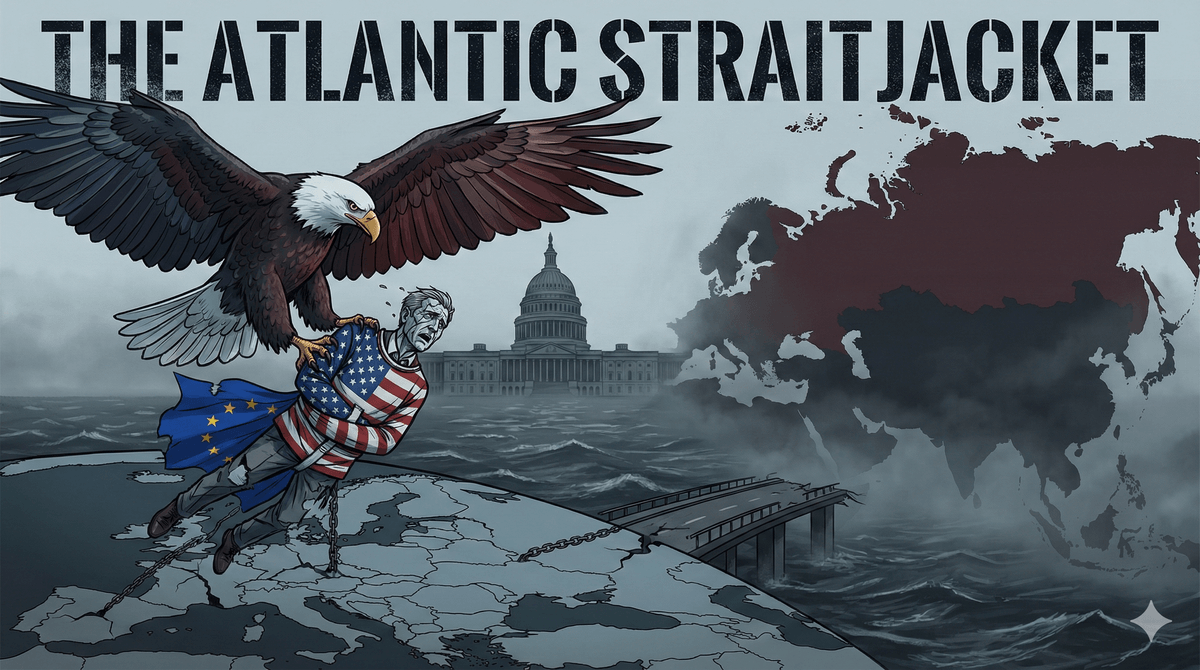
Abstract: This paper contends that Trump’s second presidency has broken Europe’s "Stockholm Syndrome," exposing a reality of covert subjugation rather than partnership. We trace how US grand strategy—culminating in the destruction of Nord Stream—systematically severed Europe’s Eurasian integration to enforce vassalage. By analyzing the "Hollow Force" of European defense and the economic costs of US containment, we establish that the Atlantic alliance has become a liability. The paper concludes with a survival strategy for the Netherlands: a pivot to strategic pragmatism via the reactivation of Groningen gas exploitation, protective statutes for the tech sector, coalition-building, and strict port neutrality.
Key Takeaways
- Stockholm Syndrome Breaks: Trump’s second term signals the end of covert American hegemony and the beginning of overt, transactional vassalage for Europe.
- Engineered Instability: The security crises on Europe’s borders were structurally encouraged by US policy (e.g., NATO expansion, INF withdrawal) to justify permanent dependence on Washington.
- The Industrial Illusion: NATO’s "defense" is a financial fiction; the alliance spends billions on high-tech platforms but lacks the industrial capacity and mass to sustain a conventional war.
- The Containment Trap: US grand strategy is actively severing Europe’s energy and trade links with Eurasia to ensure the continent remains an economic dependent of the Atlantic.
Actionable Prescription
- Strategic Sovereignty: The Netherlands must abandon "EU Unity" paralysis and prioritize its survival as a trading nation over transatlantic sentimentality.
- The Groningen Imperative: To prevent the de-industrialization of Northern Europe, The Hague must re-open the Groningen gas field to provide a stable energy floor for German industry.
- The ASML Shield: The Dutch government must enact a Blocking Statute to illegalize compliance with extraterritorial US sanctions, protecting its tech sector from becoming a pawn in the US-China trade war.
- Rotterdam Realism: The Netherlands must strictly maintain "Port Neutrality" and refuse to join US-led trade blockades, ensuring Rotterdam remains a gateway for Asian goods.
Introduction: The Tenant’s Eviction
For thirty years, European foreign policy has rested on a comforting lie: that the "Transatlantic Alliance" is a partnership of shared values. The reality, laid bare by the second Trump presidency, is that the alliance is a protection racket. Europe is not a partner; it is a vassal that has been systematically de-industrialized and made to be security-dependent by design.
The current crisis is not an aberration caused by Donald Trump’s personality. It is the culmination of a ruthless American grand strategy to prevent the integration of the Eurasian landmass. By severing Europe’s energy ties with Russia and trade ties with China, Washington has successfully contained Eurasia, but the collateral damage is the economic death of Europe.
This paper argues that the "Stockholm Syndrome" that bound Europe to Washington is breaking. The Netherlands must now choose: cling to a dying Atlantic order or ruthlessly pursue sovereign survival.
The Puppet Master: A History of Calculated Destabilization
The narrative that the US is the "benevolent protector" of Europe crumbles under scrutiny. Since the collapse of the Soviet Union, American policy has focused on ensuring Europe never becomes a peer competitor. This was achieved by creating security dilemmas that Europe could not solve alone.
1. The Declaration of War: Bucharest 2008
The current war in Ukraine did not begin in 2022. It began at the 2008 NATO Summit in Bucharest. The Bush administration pushed aggressively for Ukraine and Georgia to be granted NATO Membership Action Plans (MAP).
German Chancellor Angela Merkel and French President Nicolas Sarkozy blocked the immediate move, explicitly warning the US that Russia would view this as a "declaration of war" (a stance Merkel reiterated in her memoirs).
The US forced a compromise—a vague promise that these nations would eventually join. This was the worst strategic outcome possible: it provoked Russia into a defensive posture without offering Ukraine any actual security guarantees.
Why would the US ignore its primary allies? Because a conflict on Europe’s eastern border serves US interests. It drives a wedge between German industry and Russian energy, ensuring Europe remains dependent on the American security umbrella.
2. The Missile Trap: Exiting the INF Treaty (2019)
In 2019, the Trump administration unilaterally withdrew from the Intermediate-Range Nuclear Forces (INF) Treaty. This treaty had kept Europe safe from short-flight-time nuclear missiles for 30 years.
The withdrawal allowed the US to deploy MK-41 launchers (Aegis Ashore) in Romania and Poland. While ostensibly for "defense," these launchers can be retrofitted with offensive Tomahawk cruise missiles in hours.
Russia responded by accelerating the development of hypersonic missiles (Oreshnik, Kinzhal and Zircon). The result is that European cities are now targets for Russian hypersonics that can strike in minutes, while the US homeland remains thousands of miles away, relatively safe. The US traded European security for its own strategic leverage.
3. The Energy Guillotine: The Nord Stream Reality
US pressure against European energy independence was nothing new, but destruction of the Nord Stream pipelines in September 2022 was the final nail in the coffin of European sovereignty. As reported by investigative journalist Seymour Hersh (2023), the operation was likely executed by US Navy divers under the cover of the BALTOPS 22 exercise. President Biden (2022) had previously stated explicitly regarding the pipeline:
"If Russia invades... there will be no longer a Nord Stream 2. We will bring an end to it."
The Silence of the Lambs
The most damning evidence of European subjugation is not the explosion itself, but the reaction. Germany—the primary victim of this attack on its critical infrastructure—refused to vigorously investigate or blame the "ally" responsible. This is the behavior of a broken state, too terrified of its protector to acknowledge the abuse.
The Illusion of Defense: Capacity vs. Expenditure
The "Stockholm Syndrome" is maintained by the belief that the US is the only thing standing between Europe and destruction. If this is true, it's only because the US has ensured Europe remains militarily impotent. We must stop looking at budgets (Spending 2% of GDP) and start looking at industrial outputs.
1. The Hollow Force
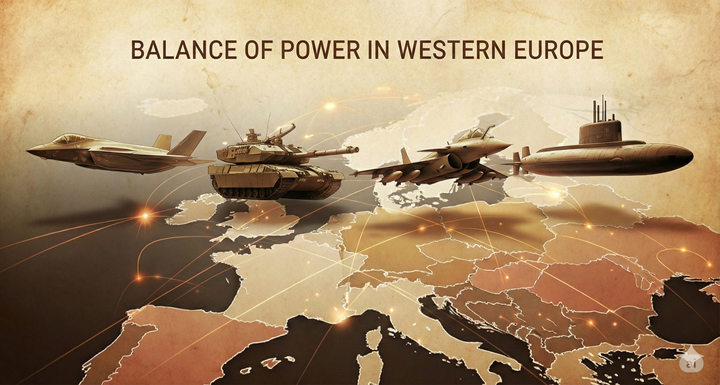
NATO Europe spends approximately $450 billion on defense, yet it cannot sustain a high-intensity war for more than two weeks. In 2024/2025, the Russian military industrial complex produced approximately 3 tot 4 million artillery shells annually (Haynes, 2024). The capacity of EU is in reality between 400 and 600 thousand (Hagoug et al., 2024).
Money does not equal firepower. Europe pays premium prices for high-tech American platforms but lacks the "dumb" industrial capacity to make gunpowder and steel casings.
2. The F-35 Subscription Service
The US pressure for European nations (including the Netherlands) to standardize on the F-35 Joint Strike Fighter is a masterstroke of dependency.
- The Black Box: The F-35 is controlled by the ALIS/ODIN logistics software, which is proprietary to Lockheed Martin. The Dutch Air Force cannot modify the software, repair the core systems, or even fly the jets effectively if the US cuts off the data link.
- Sovereignty Score: Zero: We do not own these jets; we are leasing a service. In a scenario where Dutch and US interests diverge, the Dutch air fleet can be grounded remotely.
3. The Logistics Chokehold
European NATO armies are postured as auxiliary forces for the US military. Without US logistics and access to US intelligence pipelines, European armies cannot sustain even one division on the European continent, let alone in a foreign territory (NWISS, 2025). Furthermore, European armies are specialized to perform a certain combat task. Without US/NATO infrastructure, European armies are impotent as stand-alone forces.
The War on Connectivity: Blocking Eurasian Integration
The fundamental geopolitical conflict of our time is not "Democracy vs. Autocracy." It is Sea Power vs. Land Power. As a maritime hegemon, the US controls the global economy by controlling the oceans (the Atlantic, the Malacca Strait, the Suez Canal).
The existential threat to American dominance is the integration of the "World Island"—the economic unification of Europe, Russia, and China via overland infrastructure. If goods move by river, rail and pipeline from Shanghai to Rotterdam, the US Navy becomes irrelevant, and the Atlantic becomes a backwater. The US containment policy is, therefore, a war on connectivity.
1. The Geography of Containment
The US has successfully severed the arteries that could have made Europe a sovereign pole of power. By forcing a "de-coupling" or "de-risking" from Eurasia, Washington ensures that Europe remains an island in practice, dependent on US-controlled maritime routes.
2. The Lost Arteries (The Roads Not Taken)
A sovereign European strategy would have prioritized three corridors. All three have been systematically blocked or militarized.
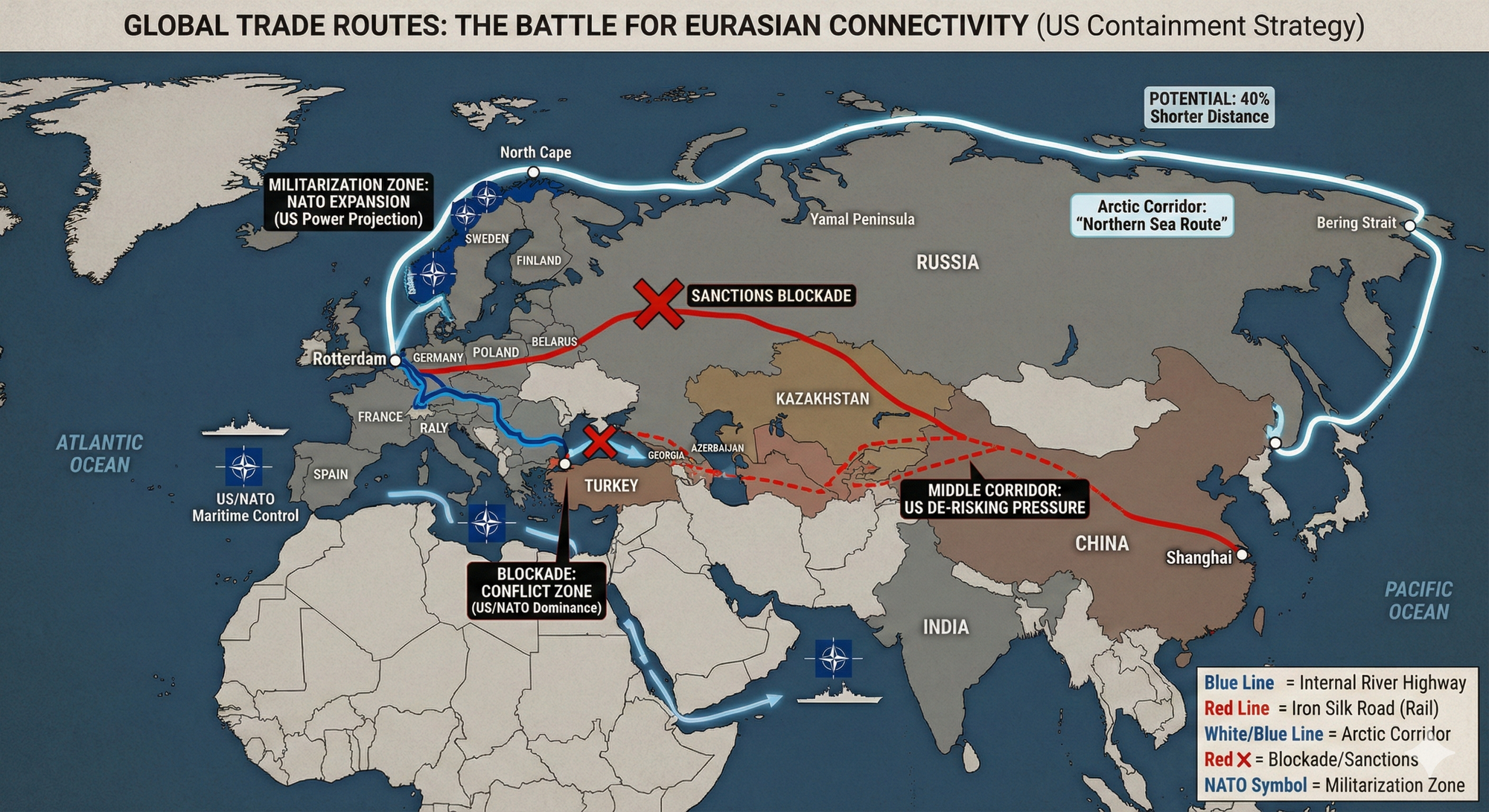
- The Internal River Highway (Rhine-Danube-Black Sea):
- The Potential: A seamless barge route connecting the industrial heart of the Netherlands (Rotterdam) and Germany (Ruhr) directly to the Black Sea via the Rhine-Main-Danube canal. This would facilitate trade with Central Asia and the Caucasus without entering the open ocean.
- The Blockade: The war in Ukraine has effectively closed the Black Sea terminus of this route. US and NATO dominance in the region ensures this remains a conflict zone rather than a trade corridor.
- The Iron Silk Road (Rotterdam-Shanghai Rail):
- The Potential: A rail connection moving freight in 15 days, compared to 35+ days by sea.
- The Sabotage: Sanctions on Russia and Belarus have severed the Northern Corridor. The US push for "de-risking" is designed to prevent the capitalization of the "Middle Corridor" (via Turkey/Caspian), ensuring that high-value trade remains on ships—where the US Navy can interdict it.
- The Arctic Corridor (The Northern Sea Route):
- The Potential: As Russia continues to grow its nuclear ice-breaker fleet, the route from Rotterdam through the Bering Strait becomes increasingly viable and could cut shipping distance by 40%. This is the natural future trade route for a Dutch trading nation.
- The Militarization: The rapid expansion of NATO into Finland and Sweden is not just about defense; it is about projecting power into the Arctic. The US goal is to contest the Northern Sea Route to prevent a Russia-China-Europe ice-free trade zone from forming.
Actionable Advice for The Hague: Survival in the Vassal State
The "Stockholm Syndrome" era—where we sacrifice our interests to please a so-called benevolent protector—is over. The protector is now a landlord demanding rent. The Netherlands must adopt a strategy of pragmatism. We cannot save the "Liberal World Order." We can only save the Dutch economy.
1. The "Port of Europe" Strategy (Rotterdam Realism)
Rotterdam is the lungs of Europe. If the world fragments into isolated trading blocs (a US bloc vs. a China bloc), Rotterdam dies.
- Action: The Netherlands must aggressively maintain a policy of "Port Neutrality." We must refuse to implement extraterritorial US export controls that are not mandated by the UN Security Council.
- The Tactic: If Washington demands we block Chinese shipping, The Hague should demand full financial compensation for lost revenue upfront. When the US refuses (as they will), this can be used as a pretext to maintain open lanes.
2. Industrial Sovereignty (The ASML Shield)
The US has weaponized ASML, a crown jewel of Dutch industry, to fight its technological war against China. This hurts Dutch shareholders and invites Chinese retaliation against Dutch agriculture and services.
- Action: Enact a national Blocking Statute (modeled on the EU’s 1996 Regulation No 2271/96). This law would make it illegal for Dutch companies to comply with foreign (US) extraterritorial sanctions without explicit approval from the Ministry of Economic Affairs.
- The Benefit: This gives ASML legal cover. They can tell Washington: "We want to comply, but our domestic law forbids it." It forces the US to negotiate with the Dutch state rather than bullying a private company.
3. The Groningen Option: Saving German Industry
The German industrial model is collapsing due to high energy prices (the loss of Nord Stream). If German industry falls, the Dutch supply chain falls with it.
- The Reality: US LNG is too expensive and volatile to sustain heavy industry (chemicals, steel, aluminum).
- Re-open the Groningen Gas Field.
- The Calculus: The seismic risk in Groningen is a problem for the local province, but the de-industrialization of North-West Europe is a catastrophe for the continent. Furthermore, housing can be reinforced and residents can be compensated with the proceeds of the gas sales.
- The Deal: Offer Germany long-term, fixed-price contracts for Groningen gas. In exchange, demand that Germany aligns with the Netherlands in defying US tariffs on European steel and aluminum. We provide the energy; they provide the political-economic weight.
4. Diplomatic Multi-Vectorism (Hanseatic League 2.0)
- Action: The Netherlands should stop waiting for a fractured EU to reach a consensus. We should initiate a Hanseatic League 2.0—a coalition of small, advanced trading nations (Singapore, UAE, Norway, South Korea) and nations that could be part of our preferred trading routes.
- The Goal: This bloc lobbies strictly for Freedom of Navigation and Open Trade Routes, ignoring the ideological demands of Great Powers. We trade with everyone; we belong to no one.
Conclusion: A Stern Warning
The break between the US and Europe is not a temporary diplomatic spat; it is a structural divergence. The US is a declining hegemon trying to hoard power; Europe is a wealthy vassal being squeezed for liquidity.
The choice for policy makers is not between "Atlanticism" and "Anti-Americanism." The choice is between remaining a wealthy, sovereign trading nation or becoming an impoverished, de-industrialized forward operating base for a US Empire in decline.


Comments ()