

Venezuela: A Disaster In The Making
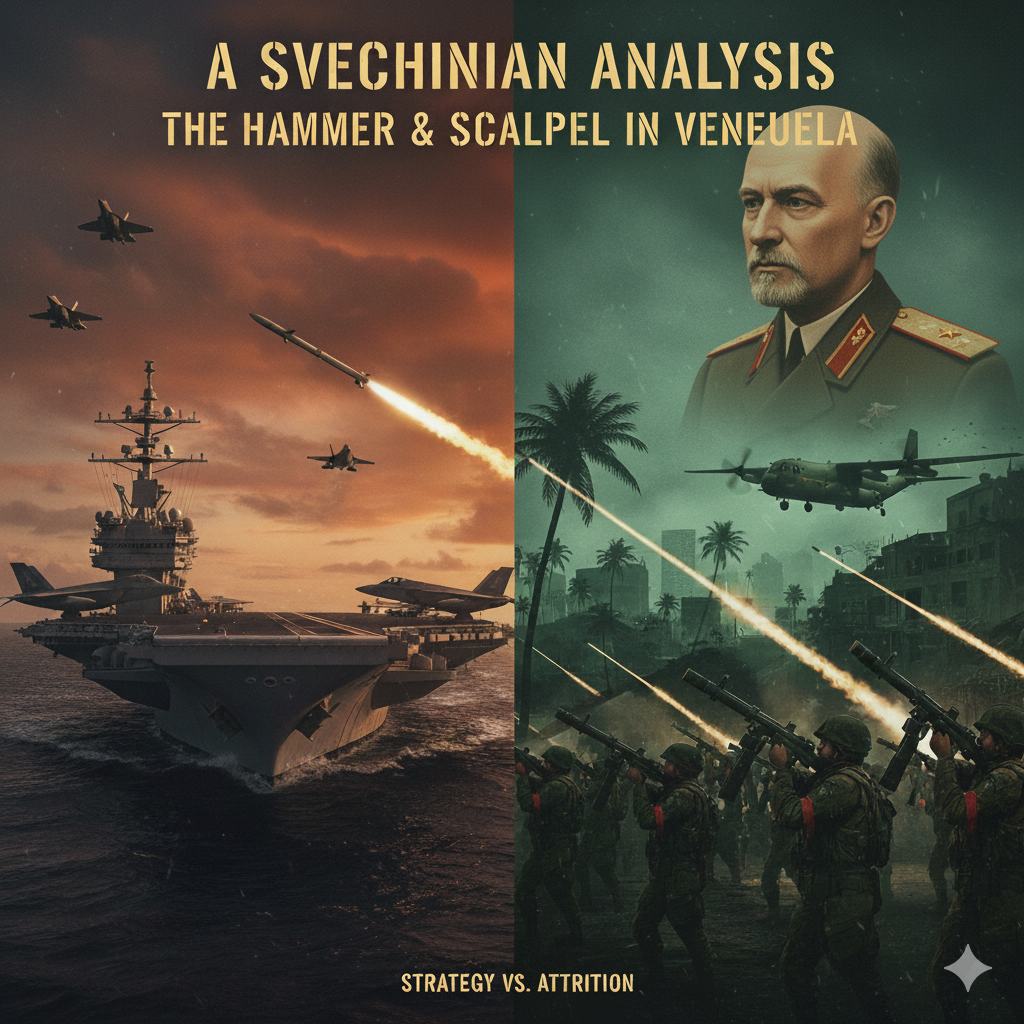
Abstract: A U.S. "Hybrid Hammer & Scalpel" operation against Venezuela represents a high-risk gamble on a Strategy of Destruction aimed at regime decapitation. This strategy is fundamentally mismatched against Venezuela's Strategy of Attrition, which is designed not to defeat the U.S. military conventionally but to inflict politically unpalatable casualties. An analysis through the lens of Alexandr Svechin suggests the U.S. operation is poised to fail if the Venezuelan regime can survive the initial 72-hour shock.
Introduction: The Strategic Problem
As of November 2025, U.S. Southern Command (SOUTHCOM) has massed a significant naval and air contingent in the Caribbean. This force includes the USS Gerald R. Ford (CVN-78) Carrier Strike Group, the Iwo Jima Amphibious Ready Group with the 22nd MEU embarked, B-52H bombers, F-35B fighters, and a potential Tomahawk land-attack missile (TLAM) package exceeding 300 missiles. Concurrently, U.S. Special Operations Command South (SOCSOUTH) elements have been identified in the region.
This paper analyzes a potential U.S. operation defined as a "Hybrid Hammer & Scalpel" scenario. This scenario posits a two-pronged attack:
- The Hammer: A massive, overt salvo of TLAMs and air strikes targeting Venezuelan command & control (C2), integrated air defenses, and key leadership locations.
- The Scalpel: A simultaneous or immediately subsequent covert/clandestine operation by SOF, supported by the 22nd MEU, to locate, capture, or eliminate the senior leadership of the Maduro regime and facilitate a political fracture.
To assess the likely outcome of this confrontation, this paper rejects conventional net assessments of materiel and instead applies the theoretical framework of Alexandr Svechin. Svechin’s work, which emphasizes the primacy of the political object and the dialectic between strategies of Destruction and Attrition, provides a more insightful lens for a deeply asymmetric conflict (Svechin, 1992).
The Svechinian Lens: A Framework for Analysis
Alexandr Svechin (1992) defined strategy as "the art of combining preparations for war and the grouping of operations for achieving the goal set by the war for armed forces" (p. 69). His framework is built on several key concepts relevant here:
- The Political Object: The political goal is the supreme determinant of strategy. A strategy of Destruction (aiming for the enemy's total overthrow) is fundamentally different from one with a Limited Aim (aiming for a negotiated settlement or partial concession).
- Destruction vs. Attrition: Svechin adopted the distinction between Niederwerfungsstrategie (destruction) and Ermattungsstrategie (attrition).
- Destruction ("sokrushenie"): Seeks victory through a single, rapid, decisive campaign that annihilates the enemy’s armed forces and their will to fight. It is a gamble for a quick, total victory.
- Attrition ("izmor"): Seeks victory by "the successive and methodical exhaustion of the enemy’s forces" (Svechin, 1992, p. 221). It is a protracted struggle that targets the enemy’s economic, moral, and political resilience—what Svechin called the "political-economic rear."
- The Rear as Center of Gravity: Svechin, writing after World War I, understood that modern wars are won not by armies at the front, but by the state’s ability to sustain the war politically and economically. The true target is the enemy’s rear.
This framework allows us to analyze the U.S. and Venezuelan forces not as a simple tally of assets, but as physical manifestations of two diametrically opposed strategic philosophies.
The U.S. Strategy of Destruction
The U.S. ORBAT (Order of Battle) is the physical tool of a Strategy of Destruction aimed at a Limited Political Object. This is a critical, and perhaps fatal, contradiction. The U.S. seeks the total political aim of regime change but through a limited military operation, not a full-scale invasion. This surgical strike model is conceptually descended from "Shock and Awe," which aims to achieve "Rapid Dominance" by shattering the adversary’s will to resist (Ullman & Wade, 1996).
Operational Art: The U.S. plan is a sequential operation:
- Phase 1 The Hammer: The 300-400+ Tomahawk missiles and bomber/fighter sorties will target Venezuela’s S-300 and Buk-M2E systems, radar sites, and C2 nodes. The goal is to achieve informational dominance and paralysis.
- Phase 2 The Scalpel: The SOF teams and their 160th SOAR (Night Stalker) aviation assets, supported by AC-130J Ghostrider gunships and the 22nd MEU, will exploit this paralysis.
The Decisive Point: The entire U.S. strategy gambles that the Hammer (destruction of materiel) will successfully enable the Scalpel (destruction of leadership), and that this, in turn, will cause the political rear of the Venezuelan state to collapse. The strategy is fast, technologically brilliant, but profoundly fragile. It wagers everything on the assumption that the enemy will collapse psychologically.
The Venezuelan Strategy of Attrition
The Venezuelan ORBAT reflects a perfect adherence to a Strategy of Attrition designed for regime survival. Venezuela has correctly identified that it cannot defeat the U.S. conventionally. It has therefore, adopted an asymmetric posture (NWISS, 2025). Its political object is not to win, but simply not to lose.
Operational Art: The Venezuelan force posture is designed to do two things:
- Survive the Hammer: The S-300s, Buks, and mobile Bal-E coastal defense missiles are not intended to win the air war. They are intended to impose a cost. They are mobile and, especially with Wagner Group advisers, will be dispersed and hidden. Their goal is to survive the initial strike and achieve a "mission kill" on a high-value asset, such as an F-35 or a destroyer.
- Break the Scalpel: This is the core of the Venezuelan strategy. The ORBAT's most important statistic is not the S-300s, but the 5,000 Igla-S (SA-24) MANPADS. This force, combined with hundreds of thousands of mobilized colectivos and militiamen, creates an "attritional blanket" over the capital. This force is cheap, ubiquitous, requires no centralized C2, and cannot be quickly eliminated by the Hammer.
The Decisive Point: Venezuela has wargamed the U.S. surgical strike and has prepared to turn the Scalpel phase into an attritional meat grinder. The Venezuelan rear is not a target to be shocked into submission, but an active weapon (the militia) to be unleashed.
The Decisive Point: The 72-Hour Attrition Trap
A Svechinian analysis of the operational sequence reveals the likely outcome of the confrontation.
Phase 1: The Hammer (Hours 0-12): The U.S. missile and air strikes are launched. They are tactically successful, destroying many fixed radar sites, known C2 bunkers, and decoy launchers. However, a significant portion of the mobile S-300/Buk systems survive by displacing, creating a contested rather than permissive airspace. The political effect is the opposite of what was intended: it provides Maduro with a "rally around the flag" moment, strengthening his moral rear.
Phase 2: The Scalpel (Hours 12-72): This is the decisive phase. U.S. SOF helicopters (MH-60s, MH-47s) and MEU Ospreys begin to insert teams into Caracas, supported by AC-130Js.
- They are met by a deluge of MANPADS fire. The low, slow-flying insertion and support aircraft are exceptionally vulnerable. The loss of several aircraft is not just possible, but statistically probable.
- The SOF teams that do land are immediately pinned down in a pre-prepared urban defense, fighting Wagner-advised militia who are not shocked but expecting them. The AC-130s, forced to fly at high altitudes by the surviving Buk/S-300 threats, cannot provide effective close air support.
Phase 3: The Quagmire (Day 3+): The U.S. strategy has failed. The Hammer did not paralyze, and the Scalpel is broken and bleeding. The U.S. President now faces the exact choice Svechin would have predicted:
- Cut losses: Withdraw, abandoning the mission and handing Maduro the greatest political victory of his life.
- Escalate: Commit the 22nd MEU to a full-scale urban rescue and assault.
If the U.S. chooses Option 2, its Strategy of Destruction has officially and catastrophically failed. It will have been sucked into Venezuela’s Strategy of Attrition. Marine units will be fighting a house-to-house battle in a city of millions, against a prepared militia, and with a collapsing political rear back home as images of casualties continue to be broadcast.
Conclusion and Strategic Implications
Alexandr Svechin (1992) warned against strategies that rely on a single blow and discount the enemy's ability to absorb punishment and prolong the conflict. The proposed U.S. Hybrid Hammer & Scalpel operation is the epitome of such a gamble.
The U.S. ORBAT is a magnificent tool for a Strategy of Destruction, but it is being applied against an opponent who has adopted a Strategy of Attrition. Venezuela has brilliantly identified the U.S. center of gravity: not the USS Gerald R. Ford, but the political will of the U.S. rear.
Venezuela's 5,000 MANPADS and mobilized militia are not a tactical force; they are a strategic weapon designed to inflict politically decisive casualties. The Svechinian analysis concludes that the U.S. operation is tactically fragile and strategically unsound. It is likely to fail within the first 72 hours, resulting in a humiliating U.S. political defeat and the strategic consolidation of the very regime it sought to destroy.



Comments ()