

Russia: The Convenient Enemy

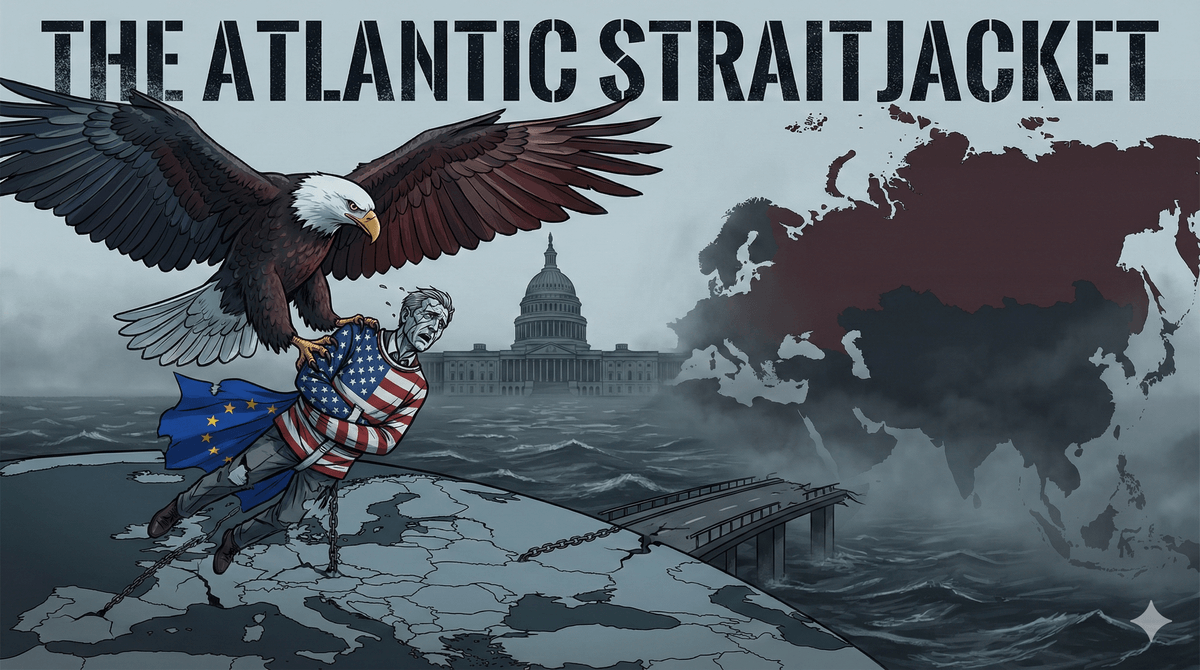
Abstract: This paper rejects the narrative of an inevitable Euro-Russian ideological clash. Utilizing a realist balance-of-power calculus, it argues that Europe and Russia possess complementary strategic and economic interests that naturally favor continental integration. Instead, the current hostility is an artificial distortion driven by two forces: an exogenous American grand strategy intent on preventing a unified Eurasian Heartland from challenging maritime hegemony, and an endogenous survival mechanism of a fragile European political elite. Facing systemic economic decay, European leaders weaponize the "Russian threat" to enforce institutional centralization and neutralize domestic populist dissent by redirecting disaffected populations toward an Eastern Front.
Europe faces a stark choice: pursue strategic autonomy through rapprochement with Moscow, or become a de-industrialized forward operating base for a decaying Atlantic empire. Finally, the paper applies this framework to the Netherlands under the current cabinet, outlining a realpolitik roadmap: redirecting its 3.5% GDP defense spending target into sovereign high-tech defense, fiercely shielding ASML’s technological sovereignty, maintaining covert Eurasian mercantile backchannels, and preserving the Port of Rotterdam’s energy infrastructure against external shocks.
Key Takeaways:
- The Netherlands must direct the 3.5% of GDP defense spending into sovereign capabilities or risk losing it in a conflict on the periphery of its interests.
- In order to achieve technological sovereignty, The Netherlands must maintain strict neutrality of its high-tech industry, or risk it becoming a pawn of foreign interests.
- By opening back-channels with Eurasian power brokers, The Netherlands can preserve an off-ramp for when the deindustrialization of Europe forces a pivot back to Eurasian trade.
- The Netherlands must expand Rotterdam's fossil fuel intake and processing capabilities to be able to process a more diversified stream of carbo-hydrates in a fractured energy market.
Introduction: The Mirage of Inevitable Conflict
In the theater of contemporary international relations, few narratives are maintained with as much ideological fervor as the structural inevitability of conflict between Europe and the Russian Federation. The dominant Western paradigm frames this dichotomy as an existential, value-driven collision: an irreconcilable struggle between liberal democratic institutions and autocracy (Paine, 2012). This presentation, however, serves primarily as theater. It obscures the underlying structural mechanics of international systems.
When pierced by a realist balance-of-power calculus, geopolitics reveals itself not as an arena of moral imperatives, but as a system governed by geographic realities, resource imperatives, and systemic security vectors. From a purely realpolitik perspective, there is no fundamental geopolitical contradiction between Europe and Russia. Left to their own organic structural mandates, the European peninsula and the Russian landmass possess complementary strategic needs rather than a zero-sum calculus.
This paper argues that the current adversarial relationship between Europe and Russia is an artificial structural distortion. It is generated and sustained by two primary forces:
- The Exogenous Vector: An American grand strategy structurally mandated to prevent the economic and physical integration of Western European technology and capital with Russian natural resources—a union that would create an un-containable challenger to maritime hegemony.
- The Endogenous Vector: A domestic survival mechanism utilized by an increasingly fragile European political elite. This political class, facing systemic economic decay and populism, weaponizes the "Russian threat" to justify rapid institutional centralization and to manage domestic threats to its own survival.
The Natural Geopolitical Congruence of Europe and Russia
To understand the artificiality of the current schism, one must map the primary security and economic imperatives of both actors independent of external systemic interference.
Russia’s Objective Strategic Mandate
The foundational driver of Russian foreign policy is geography. Deprived of natural defensive barriers on the Northern European Plain, Russia’s primary strategic interest is the maintenance of a predictable, non-hostile Western frontier.
Historically, Moscow achieves this either via expansionist strategic depth or via institutionalized neutrality on its periphery (Marshall, 2016). In the modern context, Russia lacks the demographic, economic, and bureaucratic capacity to conquer, administer, or occupy Western or Central Europe. Its actual grand strategy has been far more modest: ensuring its immediate borders are not utilized as launchpads for hostile external military alliances, while seeking mutually beneficial commercial relations and access to European markets (Kremlin, 2023).
Europe’s Imperative in a Multi-polar Order
Simultaneously, Europe is confronting a structural inflection point. The era of the unipolar world under American hegemony is drawing to a close. The global economic core is reverting to its historical mean: Asia. For Europe to retain its status as a premier global actor rather than a peripheral amusement park, it must maintain access to the broader Eurasian economic matrix.
Europe's industrial model—most explicitly demonstrated by the German manufacturing engine—requires vast, reliable, and cheap imports of energy and raw minerals to remain globally competitive. Russia possesses precisely what Europe lacks: an accessible, contiguous land reservoir of oil, natural gas, titanium, neon, agricultural fertilizers, and rare earth elements. Conversely, Western Europe possesses the advanced industrial technology, machine tools, and capital surpluses that Russia requires to modernize its economy.
The organic economic and defensive interests of both entities point toward integration rather than friction. A unified Eurasian economic zone would create a self-sustaining continental alliance immune to maritime economic warfare.
The Exogenous Vector: American Grand Strategy and the Heartland
Because a natural integration of Europe and Russia represents a structural threat to non-continental powers, external forces have systematically worked to prevent it. This is the cornerstone of American grand strategy.
The Mackinder/Spykman Geopolitical Framework
The intellectual lineage of American foreign policy is deeply rooted in Halford Mackinder’s "Heartland Theory" and Nicholas Spykman’s "Rimland" adaptations (Kumar, 2024). The core axiom of these doctrines is simple:
"Who rules East Europe commands the Heartland; Who rules the Heartland commands the World-Island; Who rules the World-Island commands the World. (Chowdhury et. al)"
From Washington’s perspective, the ultimate nightmare is the structural convergence of Western European (specifically German) industrial capital with Russian vast natural reserves and strategic depth. Such a alignment creates an autarkic economic bloc that cannot be throttled by naval blockades, effectively neutralizing the primary lever of Anglo-American blue-water naval power (NWISS, 2026). Consequently, American grand strategy has been consistently oriented toward driving a permanent structural wedge between the western and eastern poles of the Eurasian landmass.
Mechanics of the Wedge
The tools used to maintain this split are both institutional and kinetic:
- NATO Expansion as an Institutional Wall: Rather than serving as a purely defensive apparatus, modern NATO functions as a political mechanism to bind Western European capitals to Washington’s security architecture. By continuously extending its borders into Russia’s immediate sphere of interest, the alliance guarantees a permanent state of friction, forcing European states to view Russia through a securitized lens rather than a commercial one.
- Economic Infrastructure Destruction: The structural dependency of Europe on American energy is not an accident; it is a design feature. The destruction of the Nord-Stream pipelines and the imposition of sweeping sanction regimes served a vital strategic function for Washington. It forcefully dismantled the physical and financial cords connecting Europe to Eurasia, reducing European competitiveness and rendering the continent economically dependent on high-cost American liquefied natural gas (LNG) and Atlantic maritime supply lines.
The Endogenous Vector: The Domestic Utility of the External Threat
While external coercion explains the geopolitical pressure, it does not fully account for the enthusiasm with which European political elites have embraced this adversarial relationship. The escalation of hostilities serves an incredibly vital function for the internal survival of Europe's governing class.
Manufactured Consent and Institutional Centralization
The contemporary European political establishment is facing a severe crisis of legitimacy. Decades of low economic growth, demographic stagnation, and the loss of industrial competitiveness have eroded the post-WWII social contract (Steeck, 2024). In the current socioeconomic environment, this decay invites populist rebellion and political displacement.
To counter this, European elites require a state of permanent emergency. An omnipotent, external "Russian threat" acts as an ideal mechanism for domestic discipline:
| Structural Challenge | Elite Solution via "Russian Threat" |
|---|---|
| Political Opposition | Labeling domestic political opposition as "Russian disinformation" or "fifth columnists" to delegitimize dissent. |
| Economic Decline & Inflation | Reframing inflation and falling living standards as a necessary patriotic sacrifice in an economic war. |
| Fragmented European Power | Overriding national sovereignty to enforce military, fiscal, and economic centralization under Brussels. |
By maintaining a permanent state of hybrid warfare, the political class can justify unprecedented state interventions, media censorship, and the redirecting of public funds into defense-industrial complexes, all while distracting from structural domestic failures.
The Radical Calculus of Demographic Liquidation
Beyond institutional centralization, a darker, highly cynical realist hypothesis must be examined regarding the management of internal stability. Every political elite understands that the primary internal threat to its power does not come from foreign states, but from concentrated, disaffected domestic populations capable of mass civil unrest or revolution.
In Western Europe, the demographic most susceptible to populist mobilization, anti-establishment radicalization, and anti-globalist sentiment is the native, lower-to-middle class, fighting-age male population. This cohort bears the brunt of economic de-industrialization, wage stagnation, and cultural displacement.
From a ruthlessly pragmatic perspective, the escalation of a conventional or high-intensity confrontation on an Eastern Front offers a dual-use domestic solution:
- Ideological Indoctrination: It channels raw domestic frustrations away from national capitals and redirects them toward an external, foreign adversary.
- Physical Attrition: It provides an institutional framework to conscript, mobilize, and physically deploy the exact demographic most prone to civil rebellion into a high-intensity theater of conflict. By placing this population in a meat-grinder on the eastern periphery, the managerial state structurally insulates itself from the threat of native populist uprisings at home, liquidating the revolutionary segment of its own population under the guise of existential defense.
The Fork in the Road: Two Futures for Europe
Europe currently stands at a critical historical juncture. The decisions made by its leadership over the coming decade will lock the continent into one of two starkly divergent structural trajectories.
Road 1: Eurasian Rapprochement and Strategic Autonomy
Choosing this path requires European leadership to quietly break away from Atlanticist orthodoxy and pursue a cold, interest-driven accommodation with Moscow.
- The Strategy: A phased wind-down of proxy conflicts, the establishment of a new continental security architecture that respects Russian red lines (e.g., a neutral, demilitarized buffer zone in Eastern Europe), and the formal lifting of economic sanctions.
- The Outcome: Europe regains access to affordable, contiguous energy and raw materials. It stabilizes its industrial base, stops capital flight, and integrates smoothly into land-based global trade routes. By balancing its relationship between Washington, Beijing, and Moscow, Europe achieves genuine strategic autonomy, navigating the multi-polar world as an independent actor rather than an instrument of external powers.
Road 2: The De-Industrialized Outpost and Economic Collapse
Remaining on the current trajectory means accepting complete subservience to Washington's grand strategy, maintaining a permanent state of low-to-mid intensity warfare with Russia.
- The Strategy: Continuous economic decoupling from Eurasia, rapid re-militarization at the expense of domestic social infrastructure, and absolute reliance on Atlantic maritime supply lines.
- The Outcome: Rapid, permanent de-industrialization as European manufacturing becomes economically unviable due to high energy costs. Wealthy capital flees to the United States and East Asia. The continent descends into systemic poverty, enforced austerity, and hyper-militarization. Ultimately, the European Union collapses inward under the weight of its own economic contradictions and social decay, plunging the continent into a prolonged, fragmented Dark Age.
Operationalizing the Calculus: A Strategic Roadmap for The Netherlands
As of 2026, the Dutch state operates entirely within the Euro-Atlanticist paradigm. With Minister of Defence steering a defense posture that enshrines a historic 3.5% GDP spending target, the Dutch military is increasingly integrated into large-scale, German-led NATO expeditionary frameworks.
However, a highly leveraged maritime trading nation like the Netherlands cannot afford to go down with a sinking Atlanticist ship. To maximize its survival and prosperity in a fracturing global order, The Hague must quietly implement a pragmatic, realpolitik hedge.
1. Execute a Tactical Defense Hedge
The Netherlands must fulfill its 3.5% GDP defense obligation on paper to maintain its essential diplomatic standing within NATO and avoid punitive economic or political retaliations from Washington. However, the allocation of this capital must be strictly nationalized and decoupled from expeditionary land-warfare doctrines.
The current administration should resist pressure from major allies to invest heavily in mass mechanized infantry, heavy artillery, or expeditionary brigades designed to serve as cannon fodder on the Eastern European plains. Instead, defense spending must be directed into high-tech, sovereign defensive capabilities: advanced cyber-warfare divisions, localized automated air-defense networks, and naval assets optimized for protecting domestic littoral zones and North Sea critical infrastructure. The goal is to ensure that while the Netherlands pays its institutional dues, Dutch soldiers remain physically structured to protect the homeland, completely decoupled from any high-intensity warfare strategy on an Eastern Front.
2. Leverage Tech Sovereignty as a Geopolitical Shield
The crown jewel of Dutch strategic relevance in 2026 is its near-monopoly on global semiconductor manufacturing equipment via ASML and its surrounding technological ecosystem. Washington treats this as an Atlantic asset to be weaponized for decoupling from Asia and Eurasia. The Netherlands must treat it as sovereign leverage.
The Hague must quietly resist unilateral American directives aimed at total, blind technological decoupling. Dutch leadership should treat semiconductor lithography technology not as an ideological weapon, but as a geopolitical shield. By maintaining independent operational control over ASML's export policies and quietly signaling to Beijing, Moscow, and Washington that Dutch tech sovereignty is non-negotiable, the Netherlands guarantees its own survival. It ensures that any attempt by an external power to economically crush or forcefully absorb the Netherlands would carry an unacceptable global technological cost.
3. Maintain Backchannel Pragmatism and Mercantile Realism
The historical greatness of the Netherlands was built on the foundation of pragmatic, non-ideological mercantile realism; the ability to trade with all sides regardless of theological or political disputes. The current ideological stance of the European Commission is antithetical to this historical strength.
While the public-facing diplomatic corps maintains the required pro-EU, pro-NATO rhetoric, the Dutch intelligence and trade ministries must establish and preserve quiet backchannels to Eurasian power brokers. The Netherlands should positioning itself as the eventual "off-ramp" for European states when the de-industrialization crisis forces a pivot back toward Eurasian trade. By preserving relational capital with Moscow and Beijing, Dutch corporate and state assets will be positioned to rapidly exploit the reopening of continental trade routes the moment the Atlanticist alignment fractures.
4. Insulate the Domestic Economy from Energy Shock
The current European energy transition timeline, combined with the loss of pipeline gas, has left the Dutch grid and industrial sector exposed to extreme volatility and reliance on high-cost American LNG.
The Netherlands must optimize its domestic infrastructure to guarantee survival in a fragmented energy market. While publicly endorsing EU green initiatives, the government must quietly maintain, modernize, and expand the fossil-fuel intake and processing capabilities of the Port of Rotterdam. The port must remain equipped to process diverse global energy streams, whether they arrive via Atlantic shipping lanes or via resurrected Eurasian supply lines. Energy security must take absolute precedence over carbon-neutrality targets; the state cannot execute a strategic pivot if its domestic economy is structurally paralyzed by energy starvation.
Conclusion
The narrative of an inevitable, permanent war with Russia is a structural fiction designed to serve American imperial longevity and the short-term survival of a decaying European managerial elite. For a pragmatic, highly leveraged state like the Netherlands, the path forward requires piercing this narrative. By maintaining outward institutional compliance while executing an internal realpolitik hedge—focused on high-tech defense, semiconductor leverage, mercantile backchannels, and energy insulation—The Hague can successfully ride out the collapse of the Atlanticist system and secure its prosperity in the emerging multi-polar world.


Comments ()