

Salvosim: A Stochastic and Discrete-Time Salvo Combat Simulation Framework

Abstract: Modern naval combat is increasingly defined by the exchange of precision-guided munitions in highly contested environments. While Wayne Hughes’ foundational Salvo Combat Model provides a robust theoretical framework for understanding these engagements, its traditional deterministic, static applications fail to capture the critical variances inherent in modern missile defense. This paper introduces salvosim, an open-source, discrete-time stochastic simulator. By integrating configurable probability distributions, modern tactical doctrines, and discrete temporal wargaming capabilities, salvosim bridges the gap between theoretical campaign analysis and dynamic operational risk assessment.
Introduction
The proliferation of advanced anti-ship cruise missiles, anti-ship ballistic missiles, and the development of complex integrated air defense systems have fundamentally altered naval warfare. In this environment, platform survivability is heavily dependent on the probabilistic performance of sensors, interceptors, and network-centric command structures.
Wayne Hughes’ Salvo Model remains the standard theoretical tool for analyzing such discrete exchanges. However, traditional deterministic spreadsheet implementations yield single-point, continuous expected values (e.g., predicting 1.5 surviving units). Because naval combat involves discrete entities, continuous expected values fail to accurately model operational risk. Where a deterministic formulation may predict marginal force survival, stochastic modeling frequently reveals significant probabilities of catastrophic force destruction driven by variances in interceptor efficacy, electronic warfare, and environmental friction.
To address this methodological gap, this paper presents salvosim. The software provides a high-performance Monte Carlo simulation engine that evaluates discrete salvo exchanges over thousands of iterations. Furthermore, it translates these statistical outputs into an environment where analysts can perform step-by-step temporal analysis to observe exactly how specific probability distributions, launcher constraints, and tactical doctrines directly precipitate combat outcomes.
Theoretical Background & Methodological Additions
Prior to the advent of anti-ship cruise missiles, naval combat was primarily modeled using continuous-time attrition formulas, such as the Lanchester equations. However, the introduction of precision-guided munitions fundamentally altered tactical dynamics. Combat is no longer a continuous exchange of gunfire but rather a sequence of discrete, high-intensity pulses.
To quantify this, Wayne Hughes introduced the Salvo Combat Model, which remains the standard theoretical framework for evaluating missile-era engagements. The model evaluates a simultaneous exchange of weapons between two opposing fleets (Force A and Force B) in a single, discrete time-step.
The deterministic calculation for the number of units destroyed in a single salvo exchange is expressed by the following paired equations:
$$\Delta A = \frac{\beta B - z A}{a}$$$$\Delta B = \frac{\alpha A - y B}{b}$$
The variables defining the operational parameters are established as follows:
- $A$ and $B$: The initial number of active platforms (ships) in Force A and Force B prior to the salvo exchange.
- $\Delta A$ and $\Delta B$: The number of platforms destroyed or rendered combat-ineffective during the discrete time-step.
- $\alpha$ and $\beta$: The offensive striking power, defined as the number of accurately targeted missiles fired by a single unit in Force A and Force B, respectively.
- $z$ and $y$: The defensive power, defined as the number of incoming missiles a single unit in Force A and Force B can successfully intercept or decoy.
- $a$ and $b$: The staying power, defined as the quantity of missile impacts required to neutralize a single unit in Force A and Force B.
In mathematical terms, the model balances the aggregate offensive power of the attacker against the aggregate defensive capacity of the target. For Force A, the numerator $(\beta B - z A)$ represents the volume of "leakers"—the quantity of incoming munitions that successfully breach the defensive envelope. This remainder is then divided by the fleet's staying power $(a)$ to calculate platform casualties. To account for physical reality, the numerator is strictly bounded at zero; a fleet cannot sustain negative casualties if its defensive power exceeds the incoming offensive strike.
The original Hughes model conceptualizes combat in discrete exchanges, balancing an attacker's offensive striking power against a defender's defensive capability and staying power (Hughes, 1995). Salvosim utilizes this foundation but introduces specific structural expansions to accurately represent the technical parameters of modern integrated air and missile defense.
Decoupling Magazine Depth and Engagement Capacity
In classical models, a unit's defensive power is frequently treated as a singular aggregate pool. Salvosim differentiates this variable into magazine_depth (the total physical inventory of interceptors) and max_engagement_capacity (the maximum number of interceptors a platform can guide or launch simultaneously in a single time-step). This distinction is critical for modeling modern constraints, such as illuminator radar availability or vertical launch system (VLS) cycling rates.
Network-Centric Cooperative Overflow
Modern naval formations rarely fight in isolation. To model systems analogous to the Aegis Cooperative Engagement Capability (CEC), salvosim introduces a two-stage interception phase:
- Targeted Self-Defense: Threats are initially engaged by their designated target platform up to its engagement capacity.
- Cooperative Overflow: If the primary target is destroyed, experiences magazine exhaustion, or reaches engagement saturation, the threat is automatically re-allocated to the next-most-effective defender in the formation possessing spare launcher capacity.
Note: The current iteration of the model assumes continuous sensor detection and tracking capabilities. There is no independent probabilistic roll for sensor failure; any environmental degradation, electronic attack, or localized clutter must be abstracted and integrated directly into the probability distribution assigned to the defender.
Tactical Firing Doctrines
Rather than relying on a flat aggregate intercept probability, the framework allows for the assignment of specific interceptor doctrines to defenders, fundamentally altering inventory consumption rates:
- Shoot-Look-Shoot: Fires one interceptor and assesses. Conserves overall inventory but increases the risk of threat penetration under heavy saturation.
- Shoot-Shoot-Look: Salvo-launches two interceptors simultaneously per threat, doubling the magazine expenditure but significantly increasing the per-threat probability of kill.
- Max Defense: Allocates all available launcher capacity to a single threat, maximizing survivability against high-value munitions at the cost of rapid magazine depletion.
Software Architecture & Methodology
Developed in Rust for memory safety and computational efficiency, salvosim resolves 10,000 Monte Carlo iterations in under a second. The engine evaluates combat in discrete time-steps:
- Threat Generation: Attackers launch munitions according to a predefined salvo_schedule, enabling the modeling of time-phased attacks and precursor decoy waves.
- Interception Phase: Defenders engage based on capacity, doctrine, and cooperative overflow logic.
- Terminal Impact: Surviving threats resolve terminal damage against their assigned targets.
Configurable Probability Distributions
A core methodological advancement in salvosim is the handling of the Probability of Kill for both defenders (PkD) and attackers (PkO). Analysts can assign distinct random distribution profiles to account for operational variance:
| Distribution Type | Mechanism | Analytical Use Case |
|---|---|---|
| Fixed | A single constant value used for every draw. | Establishing baseline theoretical maximums. |
| Uniform Range | A random draw between defined min and max boundaries. | Modeling highly unpredictable electronic warfare environments. |
| Normal Distribution | A Gaussian draw utilizing a specific mean and standard deviation (clamped between 0 and 1). | Modeling fielded systems with known historical performance variance. |
Case Study: Contested Hormuz Transit
To demonstrate the analytical utility of the framework, salvosim was applied to "Operation Strait Breaker," a scenario derived from recent macro-level operations research regarding a contested transit of the Strait of Hormuz. Previous studies utilizing stochastic Correlation of Forces and Means (COFM) models established a 76.04% operational success rate for a People's Liberation Army Navy (PLAN) Surface Action Group opposed by a geographically constrained US Naval Central Command (NAVCENT) blockade (NWISS, 2026). While COFM establishes the macro-probability based on force composition and environmental constraints, salvosim allows for the analysis of the micro-level tactical mechanics—specifically magazine depletion and launcher saturation—that precipitate this outcome.
Scenario Design and Order of Battle
The scenario models a time-phased, multi-axis strike across four discrete simulation time-steps, pitting a geographically constrained Blue Force against a numerically superior Red Force leveraging coastal proximity.
Force Blue (Defending Force): Centered on a High-Value Unit (HVU), the CVN-76 Nimitz, the force relies on its escort screen. The CVN possesses limited magazine_depth (24) and constrained max_engagement_capacity (6), utilizing a shoot-look-shoot doctrine. The primary air defense node is a Ticonderoga-class Cruiser (CG-52) operating on shoot-look-shoot (96 cells). The screen is reinforced by three Arleigh Burke-class Destroyers (DDG-101, 102, 103), which utilize an inventory-intensive shoot-shoot-look doctrine (72 cells each) to maximize early-engagement lethality against advanced threats. To reflect littoral radar clutter, Blue Force PkD distributions are modeled as Normal Distributions centered at 0.80–0.90 with a 0.05 standard deviation.
Force Red (Attacking Force): The PLAN/Iranian alliance utilizes a staggered salvo schedule designed to induce magazine exhaustion prior to the arrival of precision strikes:
- Step 1 (Saturation): A precursor swarm of 64 Shahed-136 drones targets the CVN, alongside 44 combined Iranian coastal anti-ship missiles and PLAN supersonic ASMs targeting the screen.
- Step 2 (Follow-on): IRGCN fast boat decoys and YJ-83 subsonic cruise missiles further stress the CG and DDG magazines.
- Steps 3 & 4 (Terminal Kill): Having forced Blue inventory exhaustion, PLAN Type 055 destroyers launch primary YJ-21 Ballistic Anti-Ship Missiles alongside air-launched ASMs.
Monte Carlo Results: The Mechanics of Defensive Collapse
Execution of 10,000 Monte Carlo iterations validates the macro-level COFM findings by illuminating specific mechanical failures within the Blue Force architecture. While deterministic averages might suggest 312 aggregate VLS cells are sufficient to manage the threat volume, the stochastic data indicates a systemic collapse of the defensive screen.
| Platform | Staying Power | Survival Rate | Avg Hits Taken | Avg Interceptors Fired |
|---|---|---|---|---|
| CVN-76 Nimitz | 8 | 92.68% | 4.02 / 8 | 23.82 / 24 |
| CG-52 Ticonderoga | 4 | 0.3% | 14.16 / 4 | 95.75 / 96 |
| DDG-101 Arleigh Burke | 3 | 87.62% | 0.73 / 3 | 72 / 72 |
| DDG-102 Arleigh Burke | 3 | 97.99% | 0.25 / 3 | 72 / 72 |
| DDG-103 Arleigh Burke | 3 | 92.58% | 0.49 / 3 | 72 / 72 |
The primary air defense node, CG-52, exhibits a mere 0.3% survival rate, absorbing an average of 14.16 terminal impacts—a massive over-saturation relative to its staying power of 4. Furthermore, the three Arleigh Burke destroyers expend nearly 100% of their interceptor inventories, averaging exactly 72 out of 72 fired across all iterations.
Consequently, while the CVN-76 technically survives the engagement 92.68% of the time, it sustains an average of 4.02 terminal impacts. For an aircraft carrier, absorbing four direct impacts from cruise- or ballistic munitions constitutes a catastrophic mission kill, neutralizing its operational capability. The aggregate data unequivocally demonstrates that the doctrines assigned guarantee magazine exhaustion prior to the arrival of terminal threats.
Discrete Temporal Analysis
In addition to stochastic aggregation, the framework provides a "Walk" functionality for granular temporal analysis, supported by visual telemetry. Analyzing a single engagement trace reveals the precise mechanics of network saturation and the fatal flaw of the Blue Force's doctrinal posture.
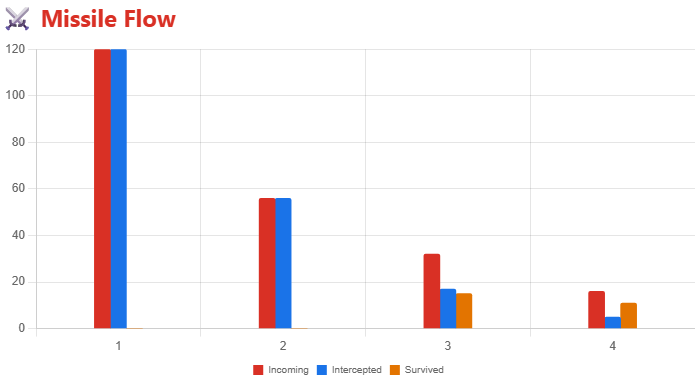
As shown in figure 1, the Aegis cooperative network achieves high interception rates during the saturation phases in Turns 1 and 2, but the resulting magazine exhaustion leads to unmitigated leakers in Turns 3 and 4.
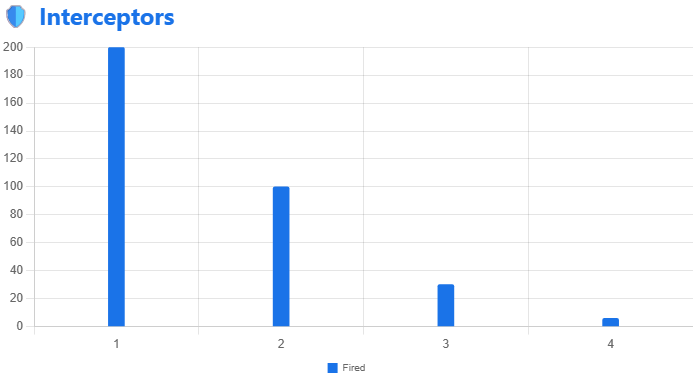
As shown in figure 2, the massive expenditure of interceptors in Turn 1 is driven by the cooperative overflow logic allocating interceptors against the low-value Shahed-136 drone swarm.
- Turn 1 (Saturation & Overflow): The Red Force initiates the strike with a heavy salvo totaling 120 incoming munitions, including 64 Shahed-136 drones targeting the CVN-76. The CVN immediately exhausts its max_engagement_capacity of 6 (achieving 4 hits). The Aegis cooperative overflow logic successfully redirects the remaining drone targets to the escort screen. Because CG-52 has the largest launcher capacity (96), it absorbs the brunt of the overflow. CG-52 fires an astounding 91 interceptors in this single time-step (achieving 80 hits), effectively emptying its 96-cell magazine to defend the CVN against low-value drones. Simultaneously, DDG-101 fires 42 interceptors, DDG-102 fires 16, and DDG-103 fires 16. The massive expenditure averts immediate destruction, but fatally compromises the screen's endurance.
- Turn 2 (Total Depletion): Follow-on supersonic ASMs and fast-boat swarms force the remaining screen to engage. CG-52 fires its final 5 interceptors, leaving it completely defenseless. DDG-103 is forced to engage heavily, firing 54 interceptors. DDG-101 fires 30 interceptors, and DDG-102 fires 16. By the end of Turn 2, the defensive network is virtually void of ammunition, having sacrificed its high-end interceptor inventory against precursor threats.
- Turn 3 (Terminal Impact - Screen Penetration): The primary Red Force precision munitions arrive, including 16 Type 055-launched YJ-21 hypersonic missiles targeting the CVN, and 16 air-launched ASMs targeting the now-defenseless CG-52. The CVN engages with its capacity of 6, achieving 6 hits. DDG-102 utilizes a portion of its remaining inventory (firing 40 interceptors), and DDG-103 fires its last 2. The unmitigated remaining munitions reach their targets. 5 missiles penetrate to reach CG-52, decisively destroying the cruiser (HP: 4 → 0).
- Turn 4 (Terminal Impact - CVN Saturation): A final salvo of 8 YJ-21s targets the CVN, and 8 air-launched ASMs target the wreckage of CG-52. The CVN fires its final 6 interceptors, achieving 6 hits. The remaining 2 YJ-21s impact the carrier directly, causing critical damage (HP: 8 → 6).
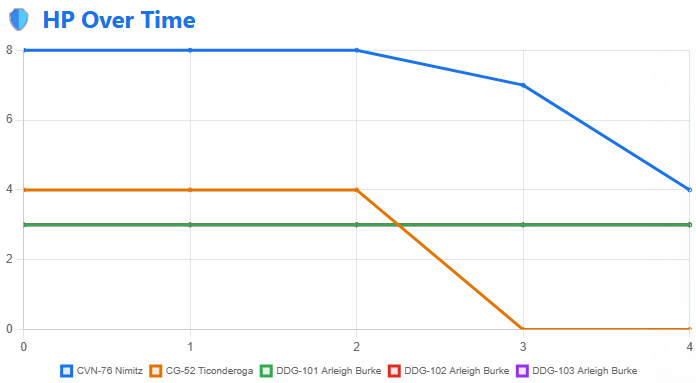
The massive magazine depletion in Turn 1 directly results in the destruction of CG-52 in Turn 3, and the critical damage sustained by CVN-76 in Turn 4 (figure 3).
This interactive visualization concretely illustrates how asymmetric mass forces the automated allocation of high-value interceptors, thereby neutralizing platform engineering advantages in constricted littorals.
Discussion and Future Work
Salvosim successfully translates static salvo equations into a dynamic, stochastic tool capable of evaluating force-structure and tactical doctrine under realistic operational variance. By operating at the discrete engagement level, it remains computationally efficient while providing nuanced insights into weapon system variance, magazine constraints, and network saturation mechanics.
The current architecture however, possesses limitations that define avenues for future research and development:
- Dynamic Doctrine Switching: Currently, a platform's doctrine is static throughout the simulation. In operational reality, command systems may shift from shoot-shoot-look to a shoot-look-shoot posture once magazine depth breaches a critical threshold to conserve ammunition. Future updates will aim to implement conditional doctrine logic based on remaining inventory.
- Threat-Specific PkD Matrices: Presently, the framework assigns a single PkD distribution to a defender, implying uniform interceptor efficacy against all threat profiles. Real-world systems require a matrix mapping. For example, a defensive platform may possess a highly reliable PkD distribution against a subsonic UAV, but a severely degraded PkD distribution against a maneuvering hypersonic glide vehicle. Implementing a Defender to Attacker Type PkD database mapping is a primary objective for subsequent iterations.
- Mixed VLS Loadout Allocation: The current model assumes that a platform's entire magazine_depth is dedicated to defensive interceptors. In reality, modern Vertical Launch Systems (VLS) feature a pre-determined fractional loadout, balancing defensive surface-to-air missiles (SAMs) with offensive strike weapons (e.g., Tomahawk, LRASM). Future versions must incorporate loadout constraints to accurately reflect the opportunity cost of allocating cells to purely defensive roles.
- Symmetrical (Two-Way) Engagements: Salvosim currently models an asymmetrical engagement paradigm wherein dedicated attackers fire upon dedicated defenders. Naval combat, however, is inherently reciprocal. Future iterations will introduce counter-battery or return-fire mechanics, allowing "defenders" to become attackers within the same time-step. This structural update will force platforms to simultaneously manage offensive salvo generation alongside defensive interception, creating a complete, two-way combat loop.
By addressing these limitations and maintaining an open-source architecture, salvosim provides a rigorously tested foundation for the next generation of unclassified naval operations research.
Appendix
The software used during this experiment has been published on Github and is available for public use.
 Mathuiss


Comments ()